

With the news feeling like one long exercise in stress-testing the fragility of the human spirit, you’d think we had better things to do than watch celebrities ‘murder’ each other with perfume bottles in a Scottish castle.
And yet, here we are. The Celebrity Traitors has gripped the nation, and I’m hooked. It turns out watching the rich and famous lie to their celebrity ‘friends’ is an excellent distraction from all the other rubbish going on in the world.
But even joyful escapism has its limits. Somewhere between watching the creation of Big/Little Mix duo between popstar Leigh-Anne Pinnock and comedian Miranda Hart, and James Acaster chicken out of traitorous tasks, I started thinking about work. Specifically, what the show’s success can teach us about our own industry.
Like The Celebrity Traitors, marketing is full of big egos, bold claims and enough hot air to make even Celia Imrie blush.
The show’s popularity illustrates the power of bringing different personalities and communities together around a shared cultural moment. However, for marketers, it raises a bigger question than who the biggest stars are around the roundtable. Namely, who are they actually influencing?
Trusting the wrong person in The Celebrity Traitors can get you banished, but in marketing it means blowing media on a famous face who doesn’t reach the people you thought they would.
So, we donned our green cloaks to run some analysis using Fifty’s platform to investigate the audiences behind the cast.
Our analysis uncovered 12 distinct audience communities and some surprising connections between the celebrities and the people they attract.
But getting the right celeb to front your campaign is only half the battle. Understanding the communities they reach also helps brands decide which creators, publishers and media environments will help them connect with those audiences.
Look beyond the celebrity image
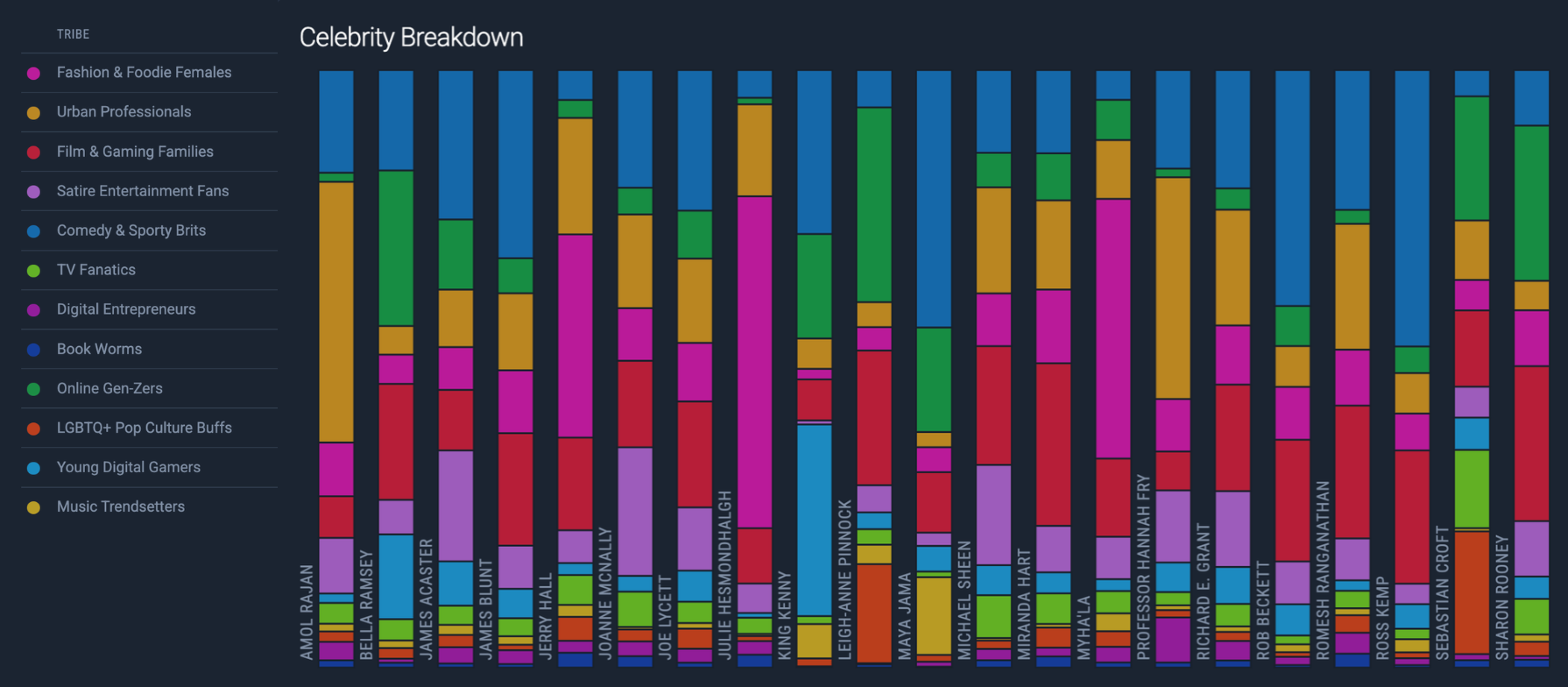
We mapped the behaviours and interests associated with the cast, clustering audiences into 12 distinct tribes. For example, among ‘Online Gen-Zers,’ Leigh-Anne Pinnock has the highest level of affinity, followed by Sharon Rooney and Bella Ramsey, then Sebastian Croft.
Our analysis also shows how one TV show can bring together a wide range of different people, and why a celebrity’s public image isn’t always a reliable guide to the people they reach.
For example, Maya Jama, known for presenting Love Island, might seem an obvious fit for a campaign targeting fashion-conscious young women.
Yet 43% of her audience affinity sits within ‘Sport and Comedy Savvy British,’ a tribe that’s 91% male and interested in football, darts and panel shows. Just 4% sit within the ‘Fashion & Foodie Females’ tribe.
Meanwhile, boxer and influencer King Kenny has a strong connection with ‘Young Digital Gamers,’ who account for 32% of his audience. That’s 5.6 times the cast average
Social followings and profiles only tell part of the story. Audience intelligence helps identify the people brands want to reach.
Two celebrities don’t always mean twice the reach
Often the instinct with investing in multiple brand ambassadors is to get the biggest names your budget will allow. The bigger the stars, the bigger the reach. But the biggest traitor in marketing might be assuming two famous faces automatically deliver two distinct audiences. Real incremental reach requires understanding how different talent can complement each other.
Instead, pairing two celebrities who probably wouldn’t end up at the same dinner party could open doors to entirely different audiences.
For example, we found a striking similarity between the audience affinity of Julie Hesmondhalgh, known for Coronation Street, and Industry star Myha’la. Despite their vastly different careers and public profiles, both show their strongest affinity with ‘Fashion & Foodie Females.’ Their tribe profiles match 81%.
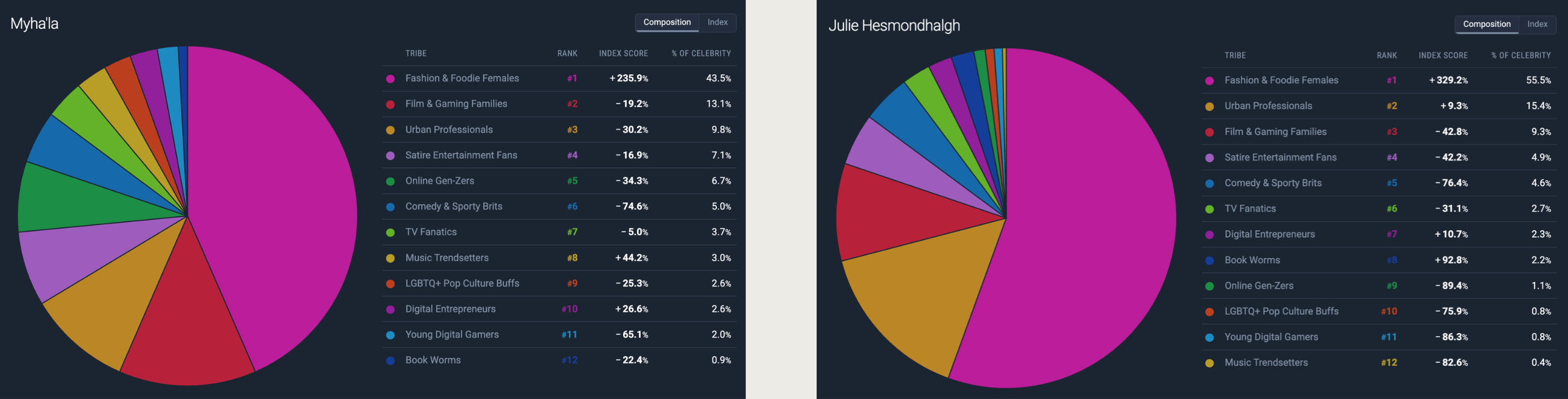
Jama and actor Ross Kemp also seem like very unlikely dinner-party companions, but at 76%, they also share a high degree of similarity in their tribe profiles.
Of course, speaking to the same people repeatedly can reinforce a message. But brands looking to expand their reach need to look at talent that attracts complementary audiences.
The smarter approach is to start with the audiences a brand wants to reach, then identify the talent most closely aligned with those communities. For a beauty brand targeting ‘UK Pop Culture Creatives,’ for example, we found a third of Pinnock’s analysed audience sits within this tribe, more than three times the cast average.
And the opportunity doesn’t stop with Pinnock herself. Understanding the wider interests and behaviours of ‘UK Pop Culture Creatives’ also reveals their affinities with platforms such as TikTok, Spotify and Netflix. That gives marketers a starting point for planning how creative, talent partnerships and paid media can work together to engage the same audience across multiple environments.
Tapping into this kind of audience intelligence can help brands identify the right creators, publishers and media environments to extend their reach. Using a celebrity ambassador might establish relevance with a particular community; then the same audience insight can help shape the creative, identify complementary talent and determine where to invest media spend to reach that audience more effectively.
Banish assumptions and stay faithful to the data
There’s a reason a lot of us keep coming back to watch The Celebrity Traitors. It’s must-see TV that asks us to look beyond appearances and question our assumptions. Marketers could do worse than take the same approach. Before signing the next big name, marketers should ask the question every traitor fears: what are they really bringing to the table?
Your casting instincts might be excellent. But they might also be as reliable as Rob Beckett trying to work out who’s deceiving the group.
The lesson extends well beyond celebrity partnerships. Whether choosing brand ambassadors, developing creative or deciding where to invest media budgets, marketers need to start with the same fundamental question: who are we trying to reach, and what do we really know about them?
By getting under the skin of who they’re trying to engage with, marketers can make better decisions about the talent they partner with, the creative they make and the media they invest in.
Because the real prize is making sure every part of the strategy is working towards the same goal. At a time when budgets are under huge scrutiny and audiences are more spread out than ever, treating talent, creative and media as separate decisions is a gamble. A deeper understanding of audiences helps brands join the dots and get more from every penny they spend.
After all, there’s enough going on in the world to worry about without adding wasting money on a poorly planned media campaign to the list.
Want to explore which cultural moments your audiences could give you permission to own? Book a demo or get in touch at [email protected].
This piece was originally published in The Drum. Find the article here.